Saturday, 1 September 2018
Master Post
Completely and utterly useless until it's more developed, but I'll pin it to the top of the blog for a quick and comprehensive link to all the important posts I'll need. Have no idea how it'll look, but maybe it'll be useful.

Friday, 7 October 2016
Completed Preliminary Task!
良かった!
(Thank god)
We have finished our prelim task! God is that a relief.
We had... many... technical errors, to say the least, so it's not up to what it could be, but for the time being it is fine. (probably)
The annotations are amusing, I pointed out many things we did wrong ;)
Now, to make some memes out of it..
Now, to make some memes out of it..
Basic Shot Types
안녀하세요! (Hello/Good morning)
Here's a few basic examples of shot types used in filming and photgraphy with a little explanation as to their effects on the audience.
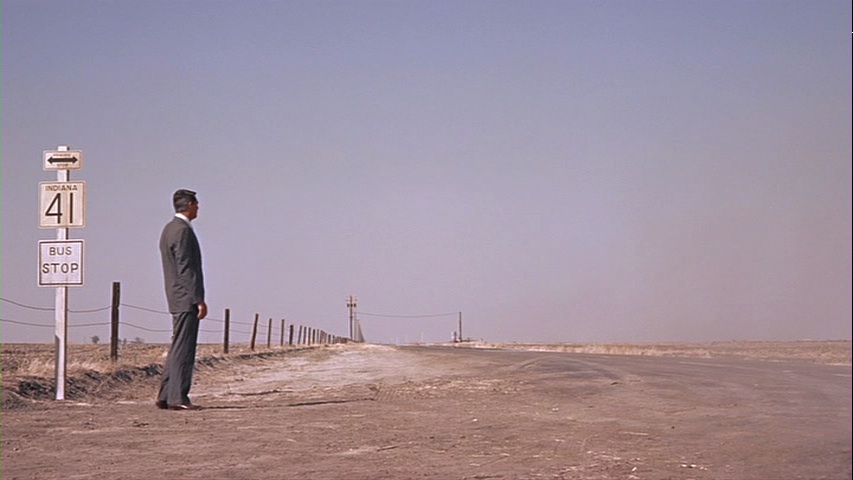



Here's a few basic examples of shot types used in filming and photgraphy with a little explanation as to their effects on the audience.
Shots focussing on people
Long Shot:
This shot type is used to show a character's surroundings and can have the effect of making the character seem dominated by their environment, as shown in the example where the character is shown to be small compared to his barren and expansive surroundings.
Medium Shot:
A medium shot is used to show a character's reaction to something (shown or not), but to also show some of their background and their stance, and gait if they are moving. This shot type usually shows the torso and face and shows less facial detail than a close up (see next). Hermione Granger (Emma Watson) is my example of a medium shot, she is casting protective spells in a forest, so a medium shot shows her arms physically casting the spells but also shows her facial features.
Notice the canted angle here? Something is clearly going very very wrong.
Close Up:
A close up is used to show a character's facial reaction to something. This shot type focuses on the face of the character and does not usually include the rest of their body. This is an effective shot type for showing the initial reactions of a character to something emotionally moving or disturbing, especially when the audience is not shown the reason for this reaction first. This example is a particularly moving one, a still from the last episode of a Korean Drama, 49 Days. The character is a "grim reaper" of sorts, and he has come to take a girl he came to consider his friend away through "the elevator" into the next life.
My feels are still very raw...
Extreme Close up:
Similar to a close up, an extreme close up (or ECU) is used to show one part of a character's face, such as their eye or mouth. This is a particularly useful shot for seeing a facial reaction without immediately recognising the character, or to focus particularly on maybe a way in which their facial expression really reflects what they're experiencing. Although the example shows about 2/3 of the character's face, I feel that it really draws the audience's attention to his eyes and therefore focuses on only one aspect of his face as oppposed to the entire thing.
Two-shot:
A two-shot is a shot that simply focuses on two characters at once. Both characters are in the frame, and can be looking at each other, away from each other, at the same thing, etc. This shot type can be used to show that two possibly unrelated characters have something in common, or are interacting with something that links them together. An example of this is from (yet another) Harry Potter film in which Harry and Hermione are looking at the same thing. The two-shot shows that they are both looking at this unknown thing at the same time, and are therefore linked because of that (disregarding their other links and using the image without context)
Shot/Reverse Shot:
This type of shot is less of an actual way of framing and filming, but more of an editing technique that expresses continuity. This is used in conversation to show that the characters are talking to each other, and to show the detail in the speaking character's face when they are talking. Here's a gif example from The Hunger Games, where Katniss and Peeta are shown conversing through the use of shot/reverse shot (although it's almost certain that the takes didn't happen in real-time with what's on-screen, it just helps with making sense of the conversation).

I do believe that is all the people-shots done, now onto the (fewer) shots that usually don't have characters in them but instead focus on the environment.
Environmental shots
Establishing shot:
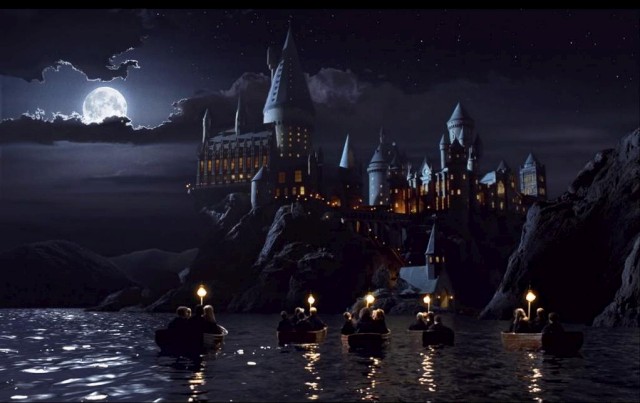
An establishing shot does what it says on the metaphorical box. It establishes where the scene or maybe whole text is going to take place. These are used to show where the events of the text are taking place. The example for this shot type again comes from Harry Potter, this is a still from when the first-years are travelling by magical boat to the castle itself. This is an effective use of establishing shots because it shows there is a location change from the train station to Hogwarts (it also looks amazing, very dark and imposing). This particular still also uses low angles to show that the castle is large and dominates the students heading towards it.
Weather shot:
This isn't something we learned in class, but I find it interesting in terms of analysing and interpreting media texts. This shot has the weather as its subject, and can also be used as the background for graphics or special effects. Weather shots can be used for pathetic fallacy, which is where the weather sets or reflects the mood of the text. For example, clear skies with sun might foreshadow a happy or positive scene. Alternatively, using a too-bright colour palette coupled with psychologically disturbing content would be effective because it puts the audience on edge before messing with their psyche (which is totally the intention for that kind of text). The example below shows a tornado taking up most of the framing, which could foreshadow that characters in the text are going to get hurt or displaced.
Thursday, 29 September 2016
Preliminary Task
Welcome, again~
Currently, we are completing a preliminary task of creating a scene that makes use of match-on-action and shot/reverse shot, amongst other things which don't immediately spring to mind (edits possible?), and observes the 180 degree rule.
The official denotations of the terms above are below (with proper citations if the links work):
Match-on-action refers to film editing and video editing techniques where the editor cuts from one shot to another view that matches the first shot's action. A common example is a man walking up to a door and reaching for the knob.
Shot reverse shot is a film technique where one character is shown looking at another character (often off-screen), and then the other character is shown looking back at the first character. Since the characters are shown facing in opposite directions, the viewer assumes that they are looking at each other.
The 180° rule is a cinematography guideline that states that two characters in a scene should maintain the same left/right relationship to one another . When the camera passes over the invisible axis connecting the two subjects, it is called crossing the line and the shot becomes what is called a reverse angle. (Description taken from a YouTube video)
All this is a pretty fanciful way to explain some filming and editing techniques that create something called continuity editing, which is editing in a way that makes the viewer feel as though they are watching the events unfold chronologically and somewhat realistically. It also helps to make sense of the scene and the position of the characters, well as their actions.
For this particular assignment, I am working with two or three other media students, shooting a noir detective scene in which the detective is paying a "contact" for information. Most of the details in the scene are very vague, and this is intended to create a mystery effect. We are trying to use more filming and editing techniques such as eyeline matching and hopefully, maybe, possibly some special effects, although I'm not very competent in After Effects unless it's somewhat basic.
We're not very far into this due to.. creative differences.. but once the ball gets really rolling there'll most likely be more details to include.
For now, ja ne!
Currently, we are completing a preliminary task of creating a scene that makes use of match-on-action and shot/reverse shot, amongst other things which don't immediately spring to mind (edits possible?), and observes the 180 degree rule.
The official denotations of the terms above are below (with proper citations if the links work):
Match-on-action refers to film editing and video editing techniques where the editor cuts from one shot to another view that matches the first shot's action. A common example is a man walking up to a door and reaching for the knob.
Shot reverse shot is a film technique where one character is shown looking at another character (often off-screen), and then the other character is shown looking back at the first character. Since the characters are shown facing in opposite directions, the viewer assumes that they are looking at each other.
The 180° rule is a cinematography guideline that states that two characters in a scene should maintain the same left/right relationship to one another . When the camera passes over the invisible axis connecting the two subjects, it is called crossing the line and the shot becomes what is called a reverse angle. (Description taken from a YouTube video)
All this is a pretty fanciful way to explain some filming and editing techniques that create something called continuity editing, which is editing in a way that makes the viewer feel as though they are watching the events unfold chronologically and somewhat realistically. It also helps to make sense of the scene and the position of the characters, well as their actions.
For this particular assignment, I am working with two or three other media students, shooting a noir detective scene in which the detective is paying a "contact" for information. Most of the details in the scene are very vague, and this is intended to create a mystery effect. We are trying to use more filming and editing techniques such as eyeline matching and hopefully, maybe, possibly some special effects, although I'm not very competent in After Effects unless it's somewhat basic.
We're not very far into this due to.. creative differences.. but once the ball gets really rolling there'll most likely be more details to include.
For now, ja ne!
Wednesday, 28 September 2016
Introductory Post
Hello, and welcome to the blog of the century...(!)
(He says really unconvincingly)I haven't studied Media at GCSE as we couldn't elect for GCSE Media here, but I chose to study AS Media because of the influence that different forms of media have on society and the ever-changing culture that seems to be shaping itself around the uses, and unfortunately abuses, of the technology that first-world cultures take for granted as an everyday "necessity".
As far as personal information goes, my birth name is Kasey Stanley, although I prefer to be known as Zephyr, and I'm a transgender agender person with he/him pronouns. I like learning about social influences and practical psychology but would not like to pursue a career in these branches. I have my sights set on teaching English as a second language to Japanese or Korean students who have willingly chosen to study at a more advanced level than is required by their curriculum.
I chose English Language, Media Studies, Maths and F. Maths to study at AS and hopefully to continue to full A-Levels.
I think that's probably all that should be said, so..
じゃね~ (Goodbye/See you later in Japanese. Read as "ja ne")
안녕히계세요 (Formal goodbye in Korean. Read as "Anyeong hi, gye se yo")
Subscribe to:
Posts (Atom)